
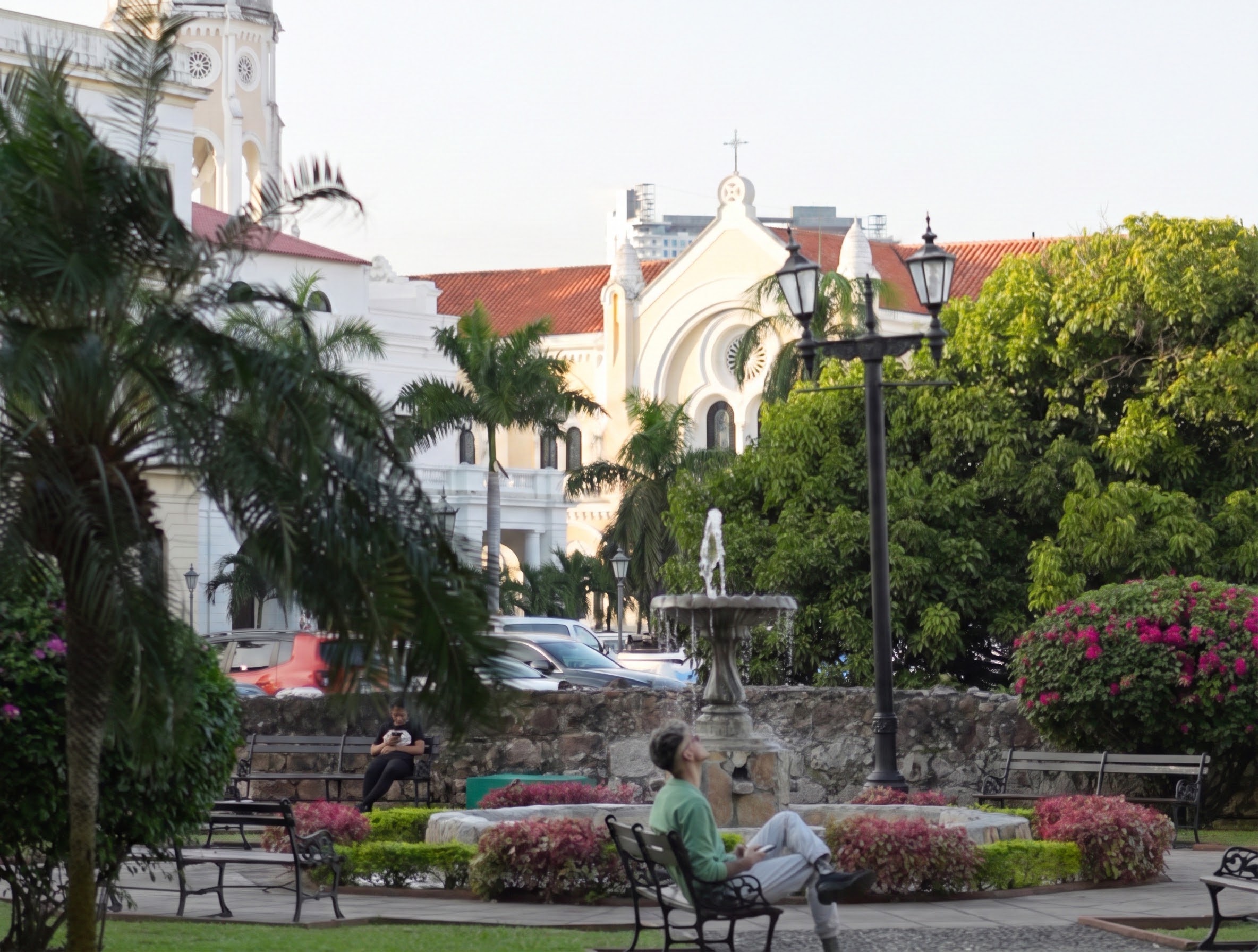
History, architecture, restaurants, things to do, daily life, and real estate in Panama City’s historic district
This historic quarter sits defiantly on a compact peninsula at the edge of the modern capital, a living testament to the city’s layered past and vibrant present. Here, church towers and restored residences stand shoulder to shoulder with small plazas, cafés, museums, hotels, and rooftop restaurants, all woven together by a narrow street grid that refuses to yield to modernity. Punta Pacífica’s gleaming skyline may rise across the bay, but within these storied streets, the experience is intimate, measured in balconies dripping with bougainvillea, centuries-old stone walls, and the footsteps echoing between one sunlit plaza and the next.
This contrast is precisely why Casco Viejo commands such recognition both in Panama City and beyond. Visitors flock here for the architectural marvels and celebrated restaurants, but it is the neighborhood’s soul, its walkability, its undeniable character that turns newcomers into residents. And for real estate buyers, the allure is unmistakable: in a city of constant reinvention, Casco Viejo offers the rarest of commodities: a finite, UNESCO-protected district with global cachet and residential opportunities that are as limited as they are coveted.
Let’s be clear: Casco Viejo is not the easiest address in Panama City. Parking is scarce, nightlife spills into the streets, and owning a centuries-old building requires a level of dedication that no modern tower can demand. Yet for those who appreciate authenticity over convenience, these are not deterrents; they are badges of honor. Casco Viejo’s way of life is something the city’s newer districts can only attempt to imitate, never replicate. Here, every challenge underscores the privilege of living in history’s embrace.
What Is Casco Viejo
Casco Viejo, also called Casco Antiguo, is Panama City’s historic district. It is centered in the corregimiento of San Felipe, immediately southwest of the modern downtown and connected to the Cinta Costera waterfront corridor. People often use Casco Viejo and Casco Antiguo interchangeably in travel, real estate, and everyday conversation.
Santa Ana sits directly west of San Felipe and increasingly appears in the broader discussion of Casco’s redevelopment. The two areas are connected, but they are not identical. Buyers should confirm the exact address, heritage designation, street conditions, and surrounding development rather than relying on the neighborhood label alone.
The historic district is part of Panama’s UNESCO-listed Colonial Transisthmian Route, a group of places that document the movement of people, goods, power, and ideas across the isthmus. For Casco Viejo, that recognition protects more than individual monuments. It also preserves the scale and urban fabric that make the neighborhood distinctive.
The History Behind Casco Viejo
Casco Viejo was founded in 1673 after the earlier settlement of Panamá Viejo was attacked in 1671 and subsequently abandoned. The new city occupied a more defensible peninsula and was built behind walls, with a street plan organized around churches, civic buildings, and public squares.
Its role changed repeatedly over the next three centuries. Casco served as Panama’s political and commercial center, absorbed new architectural influences, and later lost residents and investment as the city expanded north and east. By the late twentieth century, many buildings had deteriorated even as the district retained the country’s most important concentration of historic urban architecture.
Preservation and restoration brought a new phase. Historic buildings became residences, boutique hotels, restaurants, offices, and cultural venues. The result is still unfinished and uneven, which is part of the neighborhood’s reality. A restored block can sit close to a building awaiting rehabilitation. That tension gives Casco Viejo both its energy and its complexity as a real estate market.
Architecture That Records Several Panamas
Casco Viejo is often described as colonial, but its architecture extends beyond that label. Spanish colonial churches and stone ruins sit beside nineteenth-century residences, French- and Caribbean-influenced façades, neoclassical public buildings, and early twentieth-century apartment houses shaped by the Canal era.
The most memorable homes tend to work from the outside inward. A street façade may preserve timber doors, ironwork, shutters, or a deep balcony, while the interior opens into a courtyard or a modernized apartment. Ceiling height, cross-ventilation, shade, and interior patios were practical responses to the climate long before they became luxury selling points.
Restoration can produce exceptional residences, but historic character does not guarantee construction quality. Buyers should distinguish between cosmetic renovation and a complete rehabilitation of structure, roof, plumbing, electrical systems, waterproofing, and common areas.
The Best Things to Do in Casco Viejo
Casco Viejo is best explored on foot. A useful route begins at Plaza de la Independencia, continues through the district’s smaller plazas, and ends along the waterfront at Plaza de Francia and Paseo Esteban Huertas. The point is not to move quickly. The neighborhood rewards short detours and repeated visits.
- Plaza de la Independencia
- The district’s main civic square is bordered by the Metropolitan Cathedral, the Panama Canal Museum, historic buildings, and hotels. It provides the clearest introduction to Casco’s ceremonial architecture and political history.
- Panama Canal Museum
- Located on Plaza de la Independencia, the museum interprets Panama’s relationship with the Canal through a collection of more than 30,000 historical objects. It adds essential context to a neighborhood shaped by trade and interoceanic movement long before the modern Canal opened.
- Plaza de Francia and Paseo Esteban Huertas
- Plaza de Francia commemorates the French effort to build the Canal. From there, Paseo Esteban Huertas follows part of the old defensive wall and opens toward the bay, the Amador Causeway, and Panama City’s modern skyline. It is one of Casco’s most useful vantage points for understanding how close the old and new cities sit to one another.
- Plaza Bolívar and the National Theatre
- Plaza Bolívar is smaller and more intimate than the main square, with restaurants and shaded seating around its edges. Nearby, the National Theatre provides a more formal expression of the city’s early twentieth-century cultural ambitions.
- Museo de la Mola
- The Mola Museum presents the technique, evolution, and cultural meaning of the textile art associated with Guna women. It is a focused museum and one of the best places in the district to understand an Indigenous art form beyond its use as a souvenir.
- Arco Chato and Iglesia de San José
- The flat arch at the ruins of Santo Domingo has become one of Casco’s most photographed architectural fragments. Iglesia de San José is known for its golden altar and connects the present neighborhood to the religious buildings that organized the early walled city.
- Casco Viejo Restaurants, Cafés, and Rooftops
- Casco Viejo has become one of Panama City’s principal dining districts. Its restaurant scene works at several levels: traditional institutions, chef-led Panamanian cooking, courtyard cafés, hotel dining rooms, and rooftops built around the sunset and skyline.
What It Is Like to Live in Casco Viejo
Casco Viejo offers the closest thing Panama City has to a compact, walkable historic neighborhood. Residents can reach cafés, restaurants, museums, plazas, churches, small shops, and the waterfront without getting into a car. Ride-share service connects the district to the rest of the capital, and the Cinta Costera provides a direct route toward central neighborhoods.
Daily life is less conventional than in Punta Pacífica or Costa del Este. Grocery shopping, parking, deliveries, visitor access, and waste collection can require more planning. Some buildings have elevators, backup systems, or staffed entrances; others retain a simpler residential format. Street activity also changes from block to block.
The neighborhood suits residents who use the city actively and appreciate being close to culture and hospitality. Buyers who prioritize large amenity decks, multiple parking spaces, uniform building services, or a quiet tower environment may be more comfortable elsewhere.
Casco Viejo Real Estate
Casco Viejo real estate is defined by scarcity and variation. The district cannot expand in the way a master-planned neighborhood can, and preservation rules limit what can be demolished, altered, or built. Yet no two properties have quite the same history, condition, outlook, or relationship to the street.
Depending on current availability, buyers may find restored one- and two-bedroom apartments, larger residences created from combined historic spaces, penthouses with terraces, courtyard homes, mixed-use buildings, boutique new construction, and properties awaiting rehabilitation.
This diversity creates opportunity, but it makes broad price comparisons less useful. Consider cost per square meter alongside ceiling height, outdoor space, parking, elevator access, view, noise, restoration quality, building administration, and the legal status of every alteration.
- Established Residences and Restored Buildings
- Completed residences allow a buyer to inspect the finished architecture and understand how the building functions. They may offer immediate occupancy, a visible maintenance record, and greater certainty around views and neighboring uses. The principal risk is hidden building condition, particularly in roofs, façades, waterproofing, and shared systems.
- New and Emerging Developments
- Newer projects can introduce elevators, gyms, pools, co-working areas, structured management, and more efficient layouts while retaining a historic exterior or neighborhood scale. Gran Central, planned along Avenida Central near the heritage district, illustrates the broader direction of development with studios and one- to three-bedroom residences integrated with shops, restaurants, cultural venues, and an internationally flagged hotel. Its current projected delivery is 2027.
- Is Casco Viejo a Good Real Estate Investment
- Casco Viejo may appeal to investors because it combines limited historic supply with tourism, hospitality, corporate travel, second-home ownership, and long-term residential demand. It also carries a level of international name recognition that few Panama City neighborhoods share.
Casco’s scarcity supports the long-term story, but scarcity alone does not guarantee liquidity or rental performance. The building and block determine whether the property converts neighborhood demand into a workable investment.
Why Casco Viejo Remains a Category of Its Own
Casco Viejo occupies a position no newer Panama City neighborhood can recreate. Its streets record the city’s colonial origins, the Canal era, periods of decline, and an ongoing return of residents, hotels, restaurants, and investment.
The neighborhood’s appeal comes with real constraints. Historic buildings require care. Streets can be busy. Inventory is inconsistent. Yet those same limits preserve the low-rise scale, architectural variety, and finite supply that buyers find difficult to replace elsewhere.
For visitors, Casco Viejo is where Panama City’s history becomes visible. For residents, it offers a rare walkable life inside a fast-moving capital. For real estate buyers, it is a specialized market where the quality of the property matters as much as the power of the address.
Victoria Levitam C., Managing Partner
Contact The Agency Panama to explore available homes and private real estate opportunities in Casco Viejo.
Frequently Asked Questions
Are Casco Viejo and Casco Antiguo the Same Place
- Yes. Both names commonly refer to Panama City’s historic district centered in San Felipe. Casco Antiguo is the formal name used by many institutions, while Casco Viejo is widely used in everyday conversation, tourism, and real estate.
Why Is Casco Viejo Famous
- Casco Viejo is known for its preserved street plan, churches, plazas, historic residences, museums, restaurants, rooftops, and views across the Bay of Panama. Its historic district forms part of a UNESCO World Heritage property.
Is Casco Viejo Walkable
- Yes. It is one of Panama City’s most walkable neighborhoods. Most major plazas, museums, restaurants, and waterfront viewpoints are within a compact area, although heat, rain, cobblestones, and uneven sidewalks should be considered.
How Much Time Do You Need in Casco Viejo
- A first-time visitor can see the principal plazas and landmarks in half a day, but a full day allows time for museums, meals, shops, and the waterfront. An overnight stay reveals the neighborhood after day visitors leave and helps prospective buyers understand evening activity.
Is Casco Viejo a Good Place to Live
- It can be an excellent fit for residents who value walkability, dining, architecture, and cultural activity. Buyers should assess parking, nightlife, building services, maintenance, and block-specific conditions before choosing a home.
What Types of Real Estate Are Available in Casco Viejo
- Inventory may include restored apartments, penthouses, courtyard residences, boutique condominiums, mixed-use projects, and buildings requiring rehabilitation. Availability is limited and individual properties can differ considerably in condition and legal status.
Is Casco Viejo Real Estate a Good Investment
- Casco Viejo has a strong scarcity and destination profile, but investment performance depends on the individual property. Buyers should test rental rules, restoration quality, operating costs, noise, management, and the likely resale audience rather than relying on the neighborhood name alone.